Checkout for web games
For the web games distributed on the desktop screen, use this page to integrate the Aghanim Checkout via the API and start accepting payments for your game items online through a prebuilt checkout page.
Register with Aghanim and link your game
First, register for an Aghanim account. At the end of registration, add the link to your mobile game. It should be published in Apple App Store or Google Play Store.
Set up environment
If you want to make real payments, you are all set as the live mode is used as default. Otherwise, use a sandbox, an isolated test environment, to simulate the Aghanim events to test payments without real money movement. To turn on the sandbox mode, set the Sandbox toggle to the active position.
Sandbox supports card payments only. Alternative methods (PayPal, wallets, local payment methods) appear only in live. See Test payments for the test cards.
While integrating, you will need an S2S key to authenticate requests to the Aghanim. Keep in mind that the sandbox and live modes have different keys. Find the S2S key in Integration → API keys.
Redirect your player to Checkout page
Add a checkout button to your game that calls the server-to-server endpoint to create an Order. An Order is the programmatic representation of what the player sees when they’re redirected to the payment form in their browser.
Create Order
Every Order is associated with a player and items, they are crucial for the Checkout to work. You can use the existing players and items from your game or create them now with any data.
When passing items, each should have its SKU, a unique identifier for the item within your game backend. You can add their prices, currency, sale configuration, and more.
Orders expire 24 hours after creation.
- New data
- Existing data
To have a quick result of the integration, create an Order for any arbitrary set of data. Here, you need to fill in just your S2S key.
- cURL
- Python
- Ruby
- Node.js
- Go
curl -X POST https://api.aghanim.com/s2s/v1/orders \
  -H 'Content-Type: application/json' \
  -H 'Authorization: Bearer <YOUR_S2S_KEY>' \
  -d '{
    "player_id": "r2d2-c3po",
    "items": [
      {
        "sku": "CRS-82500",
        "name": "Magic Crystals",
        "description": "Magic Crystals."
      }
    ],
    "price_decimal": 29.99,
    "currency": "USD"
  }'
import requests, webbrowser

def create_order_and_redirect():
    payload = {
        "player_id": "r2d2-c3po",
        "items": [
            {
                "sku": "CRS-82500",
                "name": "Magic Crystals",
                "description": "Magic Crystals."
            }
        ],
        "price_decimal": 29.99,
        "currency": "USD"
    }
    headers = {"Authorization": "Bearer <YOUR_S2S_KEY>", "Content-Type": "application/json"}
    resp = requests.post("https://api.aghanim.com/s2s/v1/orders", json=payload, headers=headers)
    checkout_url = resp.json()["checkout_url"]
    webbrowser.open(checkout_url)
require 'net/http'
require 'json'
require 'uri'

def create_order_and_redirect(res)
  uri = URI("https://api.aghanim.com/s2s/v1/orders")
  req = Net::HTTP::Post.new(uri, 'Content-Type' => 'application/json', 'Authorization' => 'Bearer <YOUR_S2S_KEY>')
  req.body = {
    player_id: "r2d2-c3po",
    items: [
      {
        sku: "CRS-82500",
        name: "Magic Crystals",
        description: "Magic Crystals."
      }
    ],
    price_decimal: 29.99,
    currency: "USD"
  }.to_json

  order = JSON.parse(Net::HTTP.start(uri.hostname, uri.port, use_ssl: true) { |http| http.request(req) }.body)
  res.redirect order["checkout_url"]
end
const axios = require('axios');

async function createOrderAndRedirect(res) {
  const payload = {
    player_id: "r2d2-c3po",
    items: [
      {
        sku: "CRS-82500",
        name: "Magic Crystals",
        description: "Magic Crystals."
      }
    ],
    price_decimal: 29.99,
    currency: "USD"
  };
  const response = await axios.post('https://api.aghanim.com/s2s/v1/orders', payload, {
    headers: { 'Authorization': 'Bearer <YOUR_S2S_KEY>', 'Content-Type': 'application/json' }
  });
  res.redirect(303, response.data.checkout_url);
}
package main

import (
  "bytes"
  "encoding/json"
  "net/http"
)

func createOrderAndRedirect(w http.ResponseWriter, r *http.Request) {
  payload := map[string]interface{}{
    "player_id": "r2d2-c3po",
    "items": []map[string]interface{}{
      {
        "sku": "CRS-82500",
        "name": "Magic Crystals",
        "description": "Magic Crystals."
      }
    },
    "price_decimal": 29.99,
    "currency": "USD"
  }
  data, _ := json.Marshal(payload)
  req, _ := http.NewRequest("POST", "https://api.aghanim.com/s2s/v1/orders", bytes.NewBuffer(data))
  req.Header.Set("Authorization", "Bearer <YOUR_S2S_KEY>")
  req.Header.Set("Content-Type", "application/json")

  client := &http.Client{}
  resp, _ := client.Do(req)
  defer resp.Body.Close()

  var order map[string]interface{}
  json.NewDecoder(resp.Body).Decode(&order)
  http.Redirect(w, r, order["checkout_url"].(string), http.StatusSeeOther)
}
After you have set the integration, use the actual data.
- cURL
- Python
- Ruby
- Node.js
- Go
curl -X POST https://api.aghanim.com/s2s/v1/orders \
  -H 'Content-Type: application/json' \
  -H 'Authorization: Bearer <YOUR_S2S_KEY>' \
  -d '{
    "player_id": "r2d2-c3po",
    "items": [{"sku": "CRS-82500"}]
  }'
import requests, webbrowser

def create_order_and_redirect():
    payload = {
        "player_id": "r2d2-c3po",
        "items": [{"sku": "CRS-82500"}]
    }
    headers = {"Authorization": "Bearer <YOUR_S2S_KEY>", "Content-Type": "application/json"}
    resp = requests.post("https://api.aghanim.com/s2s/v1/orders", json=payload, headers=headers)
    checkout_url = resp.json()["checkout_url"]
    webbrowser.open(checkout_url)
require 'net/http'
require 'json'
require 'uri'

def create_order_and_redirect(res)
  uri = URI("https://api.aghanim.com/s2s/v1/orders")
  req = Net::HTTP::Post.new(uri, 'Content-Type' => 'application/json', 'Authorization' => 'Bearer <YOUR_S2S_KEY>')
  req.body = {
    player_id: "r2d2-c3po",
    items: [{ sku: "CRS-82500" }]
  }.to_json

  order = JSON.parse(Net::HTTP.start(uri.hostname, uri.port, use_ssl: true) { |http| http.request(req) }.body)
  res.redirect order["checkout_url"]
end
const axios = require('axios');

async function createOrderAndRedirect(res) {
  const payload = {
    player_id: "r2d2-c3po",
    items: [{ sku: "CRS-82500" }]
  };
  const response = await axios.post('https://api.aghanim.com/s2s/v1/orders', payload, {
    headers: { 'Authorization': 'Bearer <YOUR_S2S_KEY>', 'Content-Type': 'application/json' }
  });
  res.redirect(303, response.data.checkout_url);
}
package main

import (
  "bytes"
  "encoding/json"
  "net/http"
)

func createOrderAndRedirect(w http.ResponseWriter, r *http.Request) {
  payload := map[string]interface{}{
    "player_id":       "r2d2-c3po",
    "items":           []map[string]string{{"sku": "CRS-82500"}},
  }
  data, _ := json.Marshal(payload)
  req, _ := http.NewRequest("POST", "https://api.aghanim.com/s2s/v1/orders", bytes.NewBuffer(data))
  req.Header.Set("Authorization", "Bearer <YOUR_S2S_KEY>")
  req.Header.Set("Content-Type", "application/json")

  client := &http.Client{}
  resp, _ := client.Do(req)
  defer resp.Body.Close()

  var order map[string]interface{}
  json.NewDecoder(resp.Body).Decode(&order)
  http.Redirect(w, r, order["checkout_url"].(string), http.StatusSeeOther)
}
If you’ve already collected the player email address, pass it into the Order so the Aghanim will prefill it in the payment form. Fewer steps for the player, more respect for you.
- cURL
- Python
- Ruby
- Node.js
- Go
curl -X POST https://api.aghanim.com/s2s/v1/orders \
  -H 'Content-Type: application/json' \
  -H 'Authorization: Bearer <YOUR_S2S_KEY>' \
  -d '{
    "player_id": "r2d2-c3po",
    "items": [{"sku": "CRS-82500"}],
    "email": "pixel_warrior77@gmail.com"
  }'
import requests, webbrowser

def create_order_and_redirect():
    payload = {
        "player_id": "r2d2-c3po",
        "items": [{"sku": "CRS-82500"}],
        "email": "pixel_warrior77@gmail.com"
    }
    headers = {"Authorization": "Bearer <YOUR_S2S_KEY>", "Content-Type": "application/json"}
    resp = requests.post("https://api.aghanim.com/s2s/v1/orders", json=payload, headers=headers)
    checkout_url = resp.json()["checkout_url"]
    webbrowser.open(checkout_url)
require 'net/http'
require 'json'
require 'uri'

def create_order_and_redirect(res)
  uri = URI("https://api.aghanim.com/s2s/v1/orders")
  req = Net::HTTP::Post.new(uri, 'Content-Type' => 'application/json', 'Authorization' => 'Bearer <YOUR_S2S_KEY>')
  req.body = {
    player_id: "r2d2-c3po",
    items: [{ sku: "CRS-82500" }],
    email: "pixel_warrior77@gmail.com"
  }.to_json

  order = JSON.parse(Net::HTTP.start(uri.hostname, uri.port, use_ssl: true) { |http| http.request(req) }.body)
  res.redirect order["checkout_url"]
end
const axios = require('axios');

async function createOrderAndRedirect(res) {
  const payload = {
    player_id: "r2d2-c3po",
    items: [{ sku: "CRS-82500" }],
    email: "pixel_warrior77@gmail.com"
  };
  const response = await axios.post('https://api.aghanim.com/s2s/v1/orders', payload, {
    headers: { 'Authorization': 'Bearer <YOUR_S2S_KEY>', 'Content-Type': 'application/json' }
  });
  res.redirect(303, response.data.checkout_url);
}
package main

import (
  "bytes"
  "encoding/json"
  "net/http"
)

func createOrderAndRedirect(w http.ResponseWriter, r *http.Request) {
  payload := map[string]interface{}{
    "player_id":       "r2d2-c3po",
    "items":           []map[string]string{{"sku": "CRS-82500"}},
    "email":           "pixel_warrior77@gmail.com"
  }
  data, _ := json.Marshal(payload)
  req, _ := http.NewRequest("POST", "https://api.aghanim.com/s2s/v1/orders", bytes.NewBuffer(data))
  req.Header.Set("Authorization", "Bearer <YOUR_S2S_KEY>")
  req.Header.Set("Content-Type", "application/json")

  client := &http.Client{}
  resp, _ := client.Do(req)
  defer resp.Body.Close()

  var order map[string]interface{}
  json.NewDecoder(resp.Body).Decode(&order)
  http.Redirect(w, r, order["checkout_url"].(string), http.StatusSeeOther)
}
To make the interaction between your game and the Checkout smoother, set a deep link to return the player to after they complete the payment.
- cURL
- Python
- Ruby
- Node.js
- Go
curl -X POST https://api.aghanim.com/s2s/v1/orders \
  -H 'Content-Type: application/json' \
  -H 'Authorization: Bearer <YOUR_S2S_KEY>' \
  -d '{
    "player_id": "r2d2-c3po",
    "items": [{"sku": "CRS-82500"}],
    "back_to_game_url": "<YOUR_GAME_DEEP_LINK>"
  }'
import requests, webbrowser

def create_order_and_redirect():
    payload = {
        "player_id": "r2d2-c3po",
        "items": [{"sku": "CRS-82500"}],
        "back_to_game_url": "<YOUR_GAME_DEEP_LINK>"
    }
    headers = {"Authorization": "Bearer <YOUR_S2S_KEY>", "Content-Type": "application/json"}
    resp = requests.post("https://api.aghanim.com/s2s/v1/orders", json=payload, headers=headers)
    checkout_url = resp.json()["checkout_url"]
    webbrowser.open(checkout_url)
require 'net/http'
require 'json'
require 'uri'

def create_order_and_redirect(res)
  uri = URI("https://api.aghanim.com/s2s/v1/orders")
  req = Net::HTTP::Post.new(uri, 'Content-Type' => 'application/json', 'Authorization' => 'Bearer <YOUR_S2S_KEY>')
  req.body = {
    player_id: "r2d2-c3po",
    items: [{ sku: "CRS-82500" }],
    back_to_game_url: "<YOUR_GAME_DEEP_LINK>"
  }.to_json

  order = JSON.parse(Net::HTTP.start(uri.hostname, uri.port, use_ssl: true) { |http| http.request(req) }.body)
  res.redirect order["checkout_url"]
end
const axios = require('axios');

async function createOrderAndRedirect(res) {
  const payload = {
    player_id: "r2d2-c3po",
    items: [{ sku: "CRS-82500" }],
    back_to_game_url: "<YOUR_GAME_DEEP_LINK>"
  };
  const response = await axios.post('https://api.aghanim.com/s2s/v1/orders', payload, {
    headers: { 'Authorization': 'Bearer <YOUR_S2S_KEY>', 'Content-Type': 'application/json' }
  });
  res.redirect(303, response.data.checkout_url);
}
package main

import (
  "bytes"
  "encoding/json"
  "net/http"
)

func createOrderAndRedirect(w http.ResponseWriter, r *http.Request) {
  payload := map[string]interface{}{
    "player_id":       "r2d2-c3po",
    "items":           []map[string]string{{"sku": "CRS-82500"}},
    "back_to_game_url": "<YOUR_GAME_DEEP_LINK>",
  }
  data, _ := json.Marshal(payload)
  req, _ := http.NewRequest("POST", "https://api.aghanim.com/s2s/v1/orders", bytes.NewBuffer(data))
  req.Header.Set("Authorization", "Bearer <YOUR_S2S_KEY>")
  req.Header.Set("Content-Type", "application/json")

  client := &http.Client{}
  resp, _ := client.Do(req)
  defer resp.Body.Close()

  var order map[string]interface{}
  json.NewDecoder(resp.Body).Decode(&order)
  http.Redirect(w, r, order["checkout_url"].(string), http.StatusSeeOther)
}
Finally redirect player
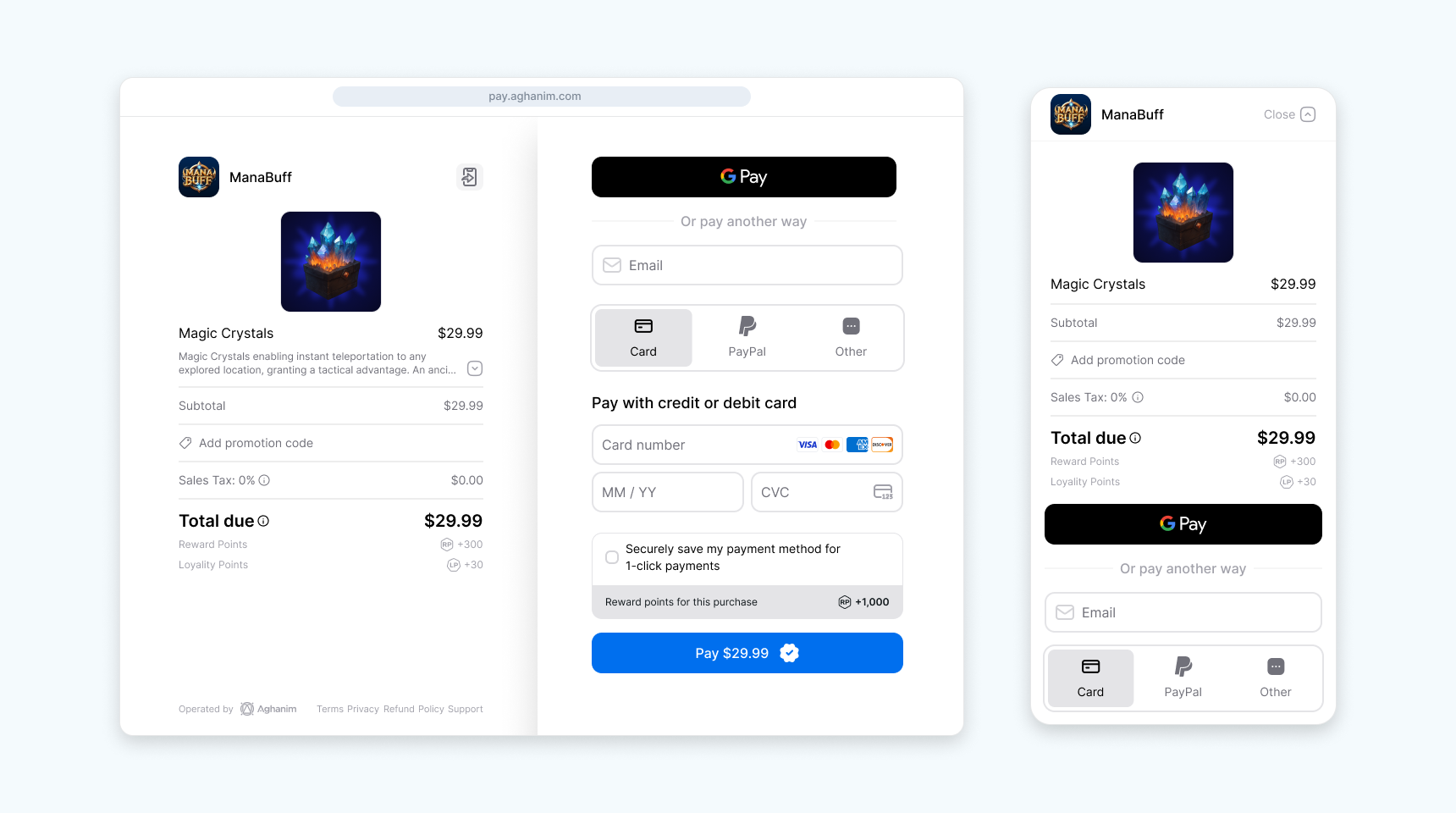
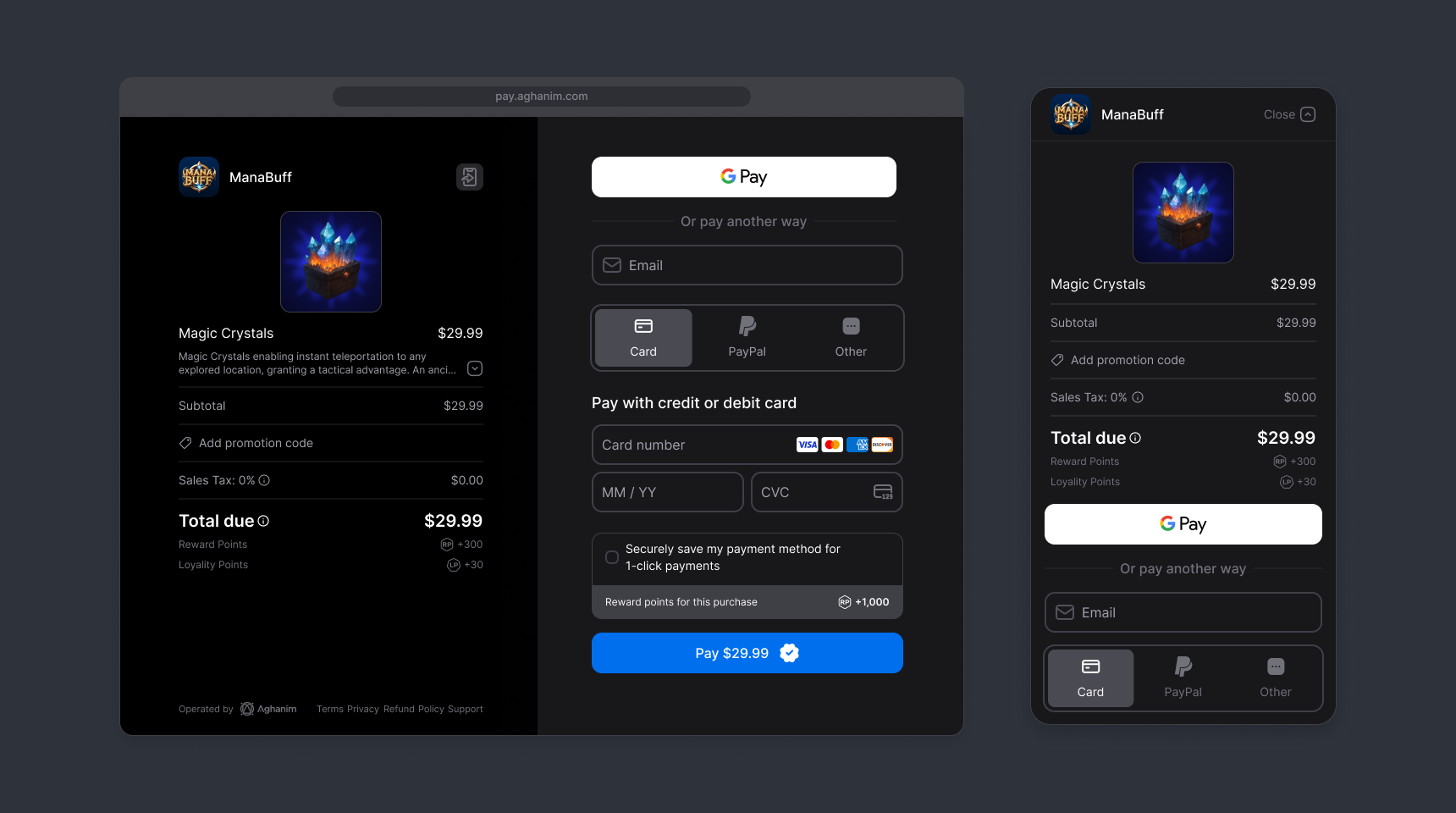
When an Order is created, receive a URL of the payment form and redirect the player to it. Open the URL in the same window, a new browser tab, or a popup window, but do not use an iframe as payment systems have limited support for it.
- JSON
{
  "order_id": "ord_eCacpFwavzi",
  "checkout_url": "https://pay.aghanim.com/order/ord_eCacpFwavzi"
}
Make payment
Make a payment. If you have set the sandbox mode, use the test card below. In the sandbox, you can make payments only with the test cards — alternative methods like PayPal, wallets, and local payment methods appear only in the live environment. The test cards accept any digits as CVV and any future date as expiry date. Don’t forget to fill in an email address to check the receipt is sent and any postal code as a billing address.
Successful payments
After you complete the payment, you will receive a receipt sent to the specified email address and a transaction record in Aghanim Dashboard → Transactions.
| Card Brand | Card Number | CVV | Expiry date | Country |
|---|---|---|---|---|
| VISA (credit) | 4242 4242 4242 4242 | Any 3 digits | Any future date | GB |
Unsuccessful payments
Make an unsuccessful payment just in case you are curious. You will see the transaction in Aghanim Dashboard → Transactions as well.
| Number | CVV | Expiry date | Response code | Description |
|---|---|---|---|---|
4832 2850 6160 9015 | Any 3 digits | Any future date | 16 | Payment declined |
For the live mode, you can find all supported payment methods in Company settings → Payment methods. Turn on or off those you see suitable. Some payment methods are available globally by default. You can’t disable Credit cards, Apple Pay, Google Pay, and PayPal.
In Checkout, the Aghanim evaluates the currency and any restrictions, then dynamically presents only the payment methods available to the player based on evaluation.
When you use the live mode, the payment form shows to the player a setting to save their payment method so they can make a one-click payment in the future.
Handle post-payment events
To complete the Checkout, handle items’ granting and chargebacks on your game backend. To do so, implement a webhook system that accepts the item.add and item.remove webhooks. See the code example with the implementation.
Comply with the Aghanim requirements for these webhooks:
- Use HTTPS schema for the single POST webhook endpoint.
- Check that webhooks are generated and signed by the Aghanim.
- Handle the
idempotency_keyfield in the webhook payload to prevent processing duplicate webhooks. - Respond with the HTTP status codes:
2xxfor successfully processed webhooks.4xxand5xxfor errors.
Grant items to player
The Aghanim sends the item.add webhook to let you know about the purchased items and ask for your permission to grant them to the player.
When the Aghanim has your 2xx answer, it can complete the checkout logic and redirect the player to a deep link if provided.
Support refunds and chargebacks
The Aghanim sends the item.remove webhook when a bank or payment system reverses the transaction, or you have requested refund in Aghanim Dashboard → Transactions. Partial refunds are not supported.
Use suggested implementation
The suggested implementation handles the webhooks mentioned before:
item.addfor granting items. You need it for integration.item.removefor refunds and chargebacks. You might need it for integration.
- Python
- Ruby
- Node.js
- Go
# Use this sample code to handle webhook events in your integration.
#
# 1. Paste this code into a new file `server.py`.
#
# 2. Install dependencies:
#    python -m pip install fastapi[all]
#
# 3. Run the server on http://localhost:8000
#    python server.py

import fastapi, hashlib, hmac, json, typing
from fastapi.responses import JSONResponse

app = fastapi.FastAPI()

@app.post("/webhook")
async def webhook(request: fastapi.Request) -> dict[str, typing.Any]:
    secret_key = "<YOUR_S2S_KEY>"  # Replace with your actual webhook secret key

    raw_payload = await request.body()
    payload = raw_payload.decode()
    timestamp = request.headers["x-aghanim-signature-timestamp"]
    received_signature = request.headers["x-aghanim-signature"]

    if not verify_signature(secret_key, payload, timestamp, received_signature):
        raise fastapi.HTTPException(status_code=403, detail="Invalid signature")

    data = json.loads(payload)
    event_type = data["event_type"]
    event_data = data["event_data"]

    if event_type == "item.add":
        add_item(event_data)
        return {"status": "ok"}

    if event_type == "item.remove":
        remove_item(event_data)
        return {"status": "ok"}

    raise fastapi.HTTPException(status_code=400, detail="Unknown event type")

def verify_signature(secret_key: str, payload: str, timestamp: str, received_signature: str) -> bool:
    signature_data = f"{timestamp}.{payload}"
    computed_hash = hmac.new(secret_key.encode(), signature_data.encode(), hashlib.sha256)
    computed_signature = computed_hash.hexdigest()
    return hmac.compare_digest(computed_signature, received_signature)

def add_item(event_data: dict[str, typing.Any]) -> None:
    # Placeholder logic for processing the event and adding item.
    # In a real application, this function would interact with your database or inventory system.
    player_id = event_data["player_id"]
    for item in event_data["items"]:
      sku = item["sku"]
      print(f"Item {sku} has been credited to player's {player_id} account.")

def remove_item(event_data: dict[str, typing.Any]) -> None:
    # Placeholder logic for processing the event and removing item.
    # In a real application, this function would interact with your database or inventory system.
    player_id = event_data["player_id"]
    for item in event_data["items"]:
      sku = item["sku"]
      print(f"Item {sku} has been removed from player's {player_id} account.")

if __name__ == "__main__":
    import uvicorn
    uvicorn.run(app, host="0.0.0.0", port=8000)
# Use this sample code to handle webhook events in your integration.
#
# 1. Paste this code into a new file `server.rb`.
#
# 2. Install dependencies:
#    gem install sinatra json hmac
#
# 3. Run the server on http://localhost:8000
#    ruby server.rb

require 'sinatra'
require 'json'
require 'openssl'

post '/webhook' do
  secret_key = "<YOUR_S2S_KEY>"  # Replace with your actual webhook secret key

  payload = request.body.read
  timestamp = request.env["HTTP_X_AGHANIM_SIGNATURE_TIMESTAMP"]
  received_signature = request.env["HTTP_X_AGHANIM_SIGNATURE"]

  unless verify_signature(secret_key, payload, timestamp, received_signature)
    halt 403, "Invalid signature"
  end

  data = JSON.parse(payload)
  event_type = data["event_type"]
  event_data = data["event_data"]

  if event_type == "item.add"
    add_item(event_data)
    return { status: "ok" }.to_json
  end

  if event_type == "item.remove"
    remove_item(event_data)
    return { status: "ok" }.to_json
  end

  halt 400, "Unknown event type"
end

def verify_signature(secret_key, payload, timestamp, received_signature)
  signature_data = "#{timestamp}.#{payload}"
  computed_signature = OpenSSL::HMAC.hexdigest('sha256', secret_key, signature_data)
  OpenSSL.secure_compare(computed_signature, received_signature)
end

def add_item(event_data)
  # Placeholder logic for processing the event and adding item.
  # In a real application, this function would interact with your database or inventory system.
  player_id = event_data["player_id"]
  for item in event_data["items"] do
    sku = item["sku"]
    puts "Item #{sku} has been credited to player's #{player_id} account."
  end
end

def remove_item(event_data)
  # Placeholder logic for processing the event and removing item.
  # In a real application, this function would interact with your database or inventory system.
  player_id = event_data["player_id"]
  for item in event_data["items"] do
    sku = item["sku"]
    puts "Item #{sku} has been removed from player's #{player_id} account."
  end
end

if __FILE__ == $0
  require 'sinatra'
  set :bind, '0.0.0.0'
  set :port, 8000
end
// Use this sample code to handle webhook events in your integration.
//
// 1. Paste this code into a new file `server.js`.
//
// 2. Install dependencies:
//    npm install express
//
// 3. Run the server on http://localhost:8000
//    node server.js

const express = require('express');
const crypto = require('crypto');

const app = express();

app.post('/webhook', express.raw({ type: "*/*" }), async (req, res) => {
  const secretKey = '<YOUR_S2S_KEY>'; // Replace with your actual webhook secret key

  const rawPayload = req.body;
  const timestamp = req.headers['x-aghanim-signature-timestamp'];
  const receivedSignature = req.headers['x-aghanim-signature'];

  if (!verifySignature(secretKey, rawPayload, timestamp, receivedSignature)) {
    return res.status(403).send('Invalid signature');
  }

  const payload = JSON.parse(req.body);
  const { event_type, event_data } = payload;

  if (event_type === 'item.add') {
    addItem(event_data);
    return res.json({ status: 'ok' });
  }

  if (event_type === 'item.remove') {
    removeItem(event_data);
    return res.json({ status: 'ok' });
  }

  return res.status(400).send('Unknown event type');
});

function verifySignature(secretKey, payload, timestamp, receivedSignature) {
  const signatureData = `${timestamp}.${payload}`;
  const computedSignature = crypto
    .createHmac('sha256', secretKey)
    .update(signatureData)
    .digest('hex');
  return crypto.timingSafeEqual(Buffer.from(computedSignature), Buffer.from(receivedSignature));
}

function addItem(event_data) {
  // Placeholder logic for processing the event and adding item.
  // In a real application, this function would interact with your database or inventory system.
  const playerId = event_data.player_id;
  for (const item of event_data.items) {
    const sku = item.sku;
    console.log(`Item ${item.sku} has been credited to player's ${playerId} account.`);
 }
}

function removeItem(event_data) {
  // Placeholder logic for processing the event and removing item.
  // In a real application, this function would interact with your database or inventory system.
  const playerId = event_data.player_id;
  for (const item of event_data.items) {
    const sku = item.sku;
    console.log(`Item ${item.sku} has been removed from player's ${playerId} account.`);
 }
}

app.listen(8000, () => {
  console.log('Server is running on http://localhost:8000');
});
// Use this sample code to handle webhook events in your integration.
//
// 1. Paste this code into a new file `server.go`.
//
// 2. Run the server on http://localhost:8000
//    go run server.go

package main

import (
  "crypto/hmac"
  "crypto/sha256"
  "encoding/hex"
  "encoding/json"
  "fmt"
  "io/ioutil"
  "net/http"
)

func webhookHandler(w http.ResponseWriter, r *http.Request) {
  secretKey := "<YOUR_S2S_KEY>"  // Replace with your actual webhook secret key

  rawPayload, _ := ioutil.ReadAll(r.Body)
  payload := string(rawPayload)
  timestamp := r.Header.Get("X-Aghanim-Signature-Timestamp")
  receivedSignature := r.Header.Get("X-Aghanim-Signature")

  if !verifySignature(secretKey, payload, timestamp, receivedSignature) {
    http.Error(w, "Invalid signature", http.StatusForbidden)
    return
  }

  var data map[string]interface{}
  if err := json.Unmarshal(rawPayload, &data); err != nil {
    http.Error(w, "Invalid payload", http.StatusBadRequest)
    return
  }

  eventType := data["event_type"].(string)
  eventData := data["event_data"].(map[string]interface{})

  if eventType == "item.add" {
    addItem(eventData)
    w.WriteHeader(http.StatusOK)
    json.NewEncoder(w).Encode(map[string]string{"status": "ok"})
    return
  }

  if eventType == "item.remove" {
    removeItem(eventData)
    w.WriteHeader(http.StatusOK)
    json.NewEncoder(w).Encode(map[string]string{"status": "ok"})
    return
  }

  http.Error(w, "Unknown event type", http.StatusBadRequest)
}

func verifySignature(secretKey, payload, timestamp, receivedSignature string) bool {
  signatureData := fmt.Sprintf("%s.%s", timestamp, payload)
  mac := hmac.New(sha256.New, []byte(secretKey))
  mac.Write([]byte(signatureData))
  computedSignature := hex.EncodeToString(mac.Sum(nil))
  return hmac.Equal([]byte(computedSignature), []byte(receivedSignature))
}

func addItem(eventData map[string]interface{}) {
  // Placeholder logic for processing the event and adding item.
  // In a real application, this function would interact with your database or inventory system.
  playerID := eventData["player_id"].(string)
  items := eventData["items"].([]interface{})
  for _, item := range items {
    itemMap := item.(map[string]interface{})
    sku := itemMap["sku"].(string)
    fmt.Printf("Item %s has been credited to player's %s account.\\n", sku, playerID)
  }
}

func removeItem(eventData map[string]interface{}) {
  // Placeholder logic for processing the event and removing item.
  // In a real application, this function would interact with your database or inventory system.
  playerID := eventData["player_id"].(string)
  items := eventData["items"].([]interface{})
  for _, item := range items {
    itemMap := item.(map[string]interface{})
    sku := itemMap["sku"].(string)
    fmt.Printf("Item %s has been removed from player's %s account.\\n", sku, playerID)
  }
}

func main() {
  http.HandleFunc("/webhook", webhookHandler)
  fmt.Println("Server is running on http://localhost:8000")
  http.ListenAndServe(":8000", nil)
}
Add webhook endpoint to Aghanim
When the webhook handling is ready, add the endpoint to the account so the Aghanim could start sending the events.
- Dashboard
- API
- Go to Integration → Webhooks.
- Click Add webhook. The site will open the Create webhook window.
- Copy and paste the URL
https://<YOUR_DOMAIN>/webhook. - Click Select events. The site will open the Select events to send window.
- Expand the Main class and select the Item add, Item remove checkboxes.
- Click Apply.
- Click Add. The site will redirect you to the webhook page.
- Click Back.
- cURL
- Python
- Ruby
- Node.js
- Go
curl -X POST https://api.aghanim.com/s2s/v1/webhooks \
  -H 'Content-Type: application/json' \
  -H 'Authorization: Bearer <YOUR_S2S_KEY>' \
  -d '{
    "events": [
      "item.add",
      "item.remove"
    ],
    "url": "https://<YOUR_DOMAIN>/webhook",
    "description": "The endpoint for all webhooks",
    "method": "POST",
    "enabled": true,
    "enabled_logs": true,
    "player_context_enabled": true
  }'
import requests

def create_webhook():
    payload = {
        "events": ["item.add", "item.remove"],
        "url": "https://<YOUR_DOMAIN>/webhook",
        "description": "The endpoint for all webhooks",
        "method": "POST",
        "enabled": True,
        "enabled_logs": True,
        "player_context_enabled": True
    }

    headers = {"Authorization": "Bearer <YOUR_S2S_KEY>", "Content-Type": "application/json"}
    resp = requests.post("https://api.aghanim.com/s2s/v1/webhooks", json=payload, headers=headers)
    return resp.json()
require 'net/http'
require 'json'
require 'uri'

def create_webhook
  uri = URI("https://api.aghanim.com/s2s/v1/webhooks")
  req = Net::HTTP::Post.new(uri, 'Content-Type' => 'application/json', 'Authorization' => 'Bearer <YOUR_S2S_KEY>')
  req.body = {
    events: ["item.add", "item.remove"],
    url: "https://<YOUR_DOMAIN>/webhook",
    description: "The endpoint for all webhooks",
    method: "POST",
    enabled: true,
    enabled_logs: true,
    player_context_enabled: true
  }.to_json

  res = Net::HTTP.start(uri.hostname, uri.port, use_ssl: true) { |http| http.request(req) }
  JSON.parse(res.body)
end
const axios = require('axios');

async function createWebhook() {
  const payload = {
    events: ["item.add", "item.remove"],
    url: "https://<YOUR_DOMAIN>/webhook",
    description: "The endpoint for all webhooks",
    method: "POST",
    enabled: true,
    enabled_logs: true,
    player_context_enabled: true
  };

  const res = await axios.post('https://api.aghanim.com/s2s/v1/webhooks', payload, {
    headers: { 'Authorization': 'Bearer <YOUR_S2S_KEY>', 'Content-Type': 'application/json' }
  });
  return res.data;
}
package main

import (
	"bytes"
	"encoding/json"
	"net/http"
)

func createWebhook() map[string]interface{} {
	payload := map[string]interface{}{
		"events":                 []string{"item.add", "item.remove"},
		"url":                    "https://<YOUR_DOMAIN>/webhook",
		"description":            "The endpoint for all webhooks",
		"method":                 "POST",
		"enabled":                true,
		"enabled_logs":           true,
		"player_context_enabled": true,
	}
	data, _ := json.Marshal(payload)

	req, _ := http.NewRequest("POST", "https://api.aghanim.com/s2s/v1/webhooks", bytes.NewBuffer(data))
	req.Header.Set("Authorization", "Bearer <YOUR_S2S_KEY>")
	req.Header.Set("Content-Type", "application/json")

	client := &http.Client{}
	resp, _ := client.Do(req)
	defer resp.Body.Close()

	var webhook map[string]interface{}
	json.NewDecoder(resp.Body).Decode(&webhook)
	return webhook
}
Test your integration
After you have handled the webhooks, check that the purchased items are in your inventory. That’s all.
Next steps
- See Currency codes and minor units to learn how the Aghanim represents monetary amounts.
- See Payment Webhook to learn about the payment progress when the player visits the payment form.
Need help?
Contact our integration team at integration@aghanim.com